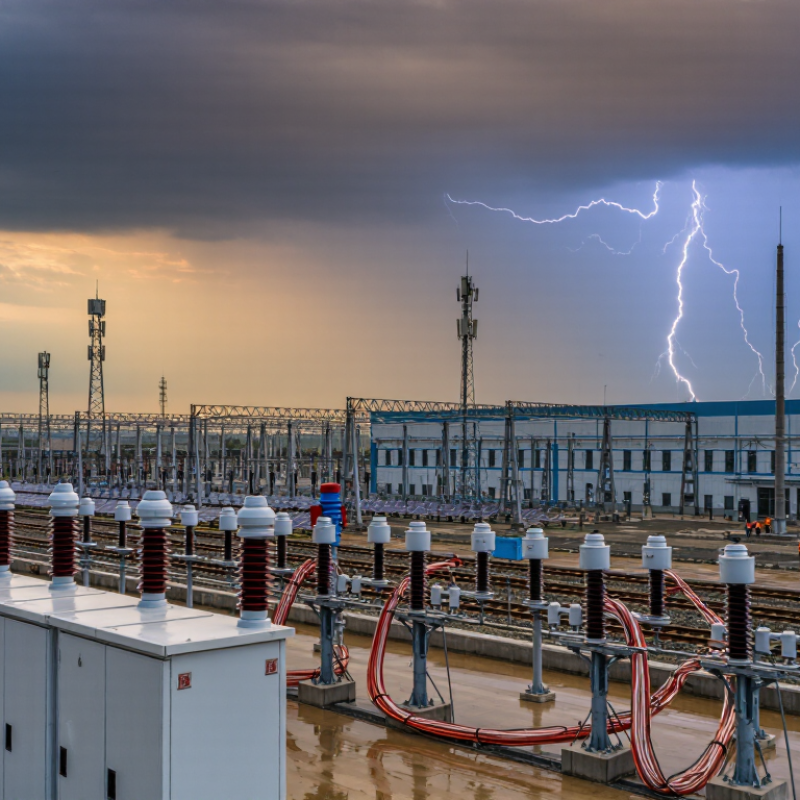
China Best Lightning Arrestor Manufacturers and Suppliers?
China’s Lightning Arrestor market serves factories, data centers, railways, solar farms, and commercial buildings worldwide. Supplier quality matters.
Vaisala’s 2023 Annual Lightning Report recorded more than 1.39 billion lightning events worldwide. That figure shows the scale of electrical risk. However, lightning frequency does not determine product quality alone. A reliable Lightning Arrestor must match the system voltage, grounding design, impulse current, and installation environment.
The IEC 62305 series provides an internationally recognized framework for lightning protection design. IEC 61643-11 also addresses surge protective devices connected to low-voltage power systems. These standards help buyers compare test methods, discharge ratings, and installation requirements. They do not make every factory equally reliable.
Lightning researcher Dr. Martin A. Uman described lightning as “a gigantic electrical spark.” That simple phrase explains why small design errors can create serious equipment damage. A poorly bonded earth conductor may leave visible burn marks near a cabinet. A weak arrester may fail before maintenance teams notice abnormal heating.
This guide examines China’s leading Lightning Arrestor manufacturers and suppliers through a practical E-E-A-T lens. It considers factory experience, engineering capability, certification evidence, testing facilities, export performance, and after-sales support. Public reports can be incomplete. Supplier websites can also overstate performance.
That is why verification remains essential. Buyers should request type-test reports, traceable certificates, product drawings, and installation references. The cheapest quotation may not be the lowest long-term cost. In some projects, the wrong arrester creates more risk than no arrester.
What Is a Lightning Arrestor and How Does It Work?
A lightning arrestor, often called a surge arrester, protects electrical equipment from sudden overvoltage.
It redirects the surge. During normal operation, its internal metal-oxide varistor remains highly resistive. When a lightning impulse raises the voltage, the varistor changes behavior within microseconds. It creates a low-resistance path to ground and diverts damaging energy away from transformers, panels, and cables. After the impulse passes, it returns to its insulating state.
In a typical installation, the arrester connects in parallel between the conductor and earth, not in series. Short leads matter. A long grounding wire adds inductive impedance, allowing voltage to rise at equipment terminals.
Correct bonding, conductor sizing, and earth continuity are as important as the arrester rating. Technicians select protection according to system voltage, temporary overvoltage, exposure, and discharge class. A device rated too low may fail repeatedly; one rated too high may provide inadequate protection.
Reliable suppliers should provide test data, leakage-current limits, enclosure details, and traceable production records. Inspection should check cracked housings, loose terminals, moisture entry, and heat damage.
A practical warning: a healthy-looking arrester can still be electrically exhausted after severe events. Replacement decisions should follow measured condition and local electrical requirements, not appearance alone. I would also question any installation that lacks a short, direct grounding route. That detail is often overlooked.
Key Lightning Arrestor Types Made in China
China Best Lightning Arrestor Manufacturers and Suppliers?
China produces several lightning arrestor types for power, communication, railway, and industrial systems. Metal oxide arrestors are widely used because they respond quickly and require no series gap. They help divert surge energy while maintaining low leakage during normal operation. Gap-type arrestors remain useful in selected medium-voltage applications. Their structure is simple, but maintenance and coordination require careful attention.
Station-class arrestors protect substations and transformers from severe impulse currents. Distribution-class models suit overhead lines, compact substations, and commercial facilities. Polymer-housed versions are lighter and resist moisture better than traditional porcelain designs. For sensitive equipment, manufacturers also produce low-voltage, photovoltaic, and signal-line arrestors. These products must match the system voltage, grounding method, discharge current, and installation environment.
A reliable Chinese supplier should provide impulse-current test records, leakage-current data, thermal stability results, and clear production traceability. During practical selection, engineers often inspect sealing quality, terminal strength, housing thickness, and pressure-relief performance. Small details matter. A poor cable bend can weaken protection. Factory customization may include mounting brackets, creepage distance, enclosure color, and connector design. However, customization is not automatically an improvement. I have seen specifications become complicated without improving field safety. Buyers should review test evidence, applicable standards, and replacement procedures before approving a design. Periodic inspection remains necessary, especially in areas with frequent storms, salt pollution, or unstable grounding.
How to Evaluate China’s Best Manufacturers and Suppliers
China Best Lightning Arrestor Manufacturers and Suppliers?
How to Evaluate China’s Best Manufacturers and Suppliers
Choosing a lightning arrester supplier requires more than comparing prices. Check whether the manufacturer understands your system voltage, grounding method, pollution level, and installation environment. A reliable supplier should recommend suitable continuous operating voltage and discharge current ratings.
Ask for clear technical documents. These may include product drawings, material specifications, routine test records, and type-test reports from qualified laboratories. Check alignment with relevant IEC requirements, especially for metal-oxide surge arresters. Serial numbers and batch records should support product traceability.
Factory experience matters. Request photographs of production lines, sealing processes, aging tests, and final inspections. If possible, arrange an independent factory audit. A sample test can reveal leakage current, insulation quality, and housing defects that brochures may not show.
Do not ignore communication. Engineers should explain protection levels without vague claims. They should also confirm delivery schedules, packaging details, replacement procedures, and warranty conditions in writing. One practical lesson is simple: a polished catalog is not proof of stable manufacturing.
Small details matter.
Compare several samples from different batches, not only one carefully selected unit. Review how the supplier handles technical corrections, because honest answers often matter more than perfect promises. A manufacturer that records failures and improves processes may be more dependable than one claiming zero problems.
Manufacturing Standards, Testing, and Quality Control
Selecting a Chinese lightning arrestor manufacturer requires more than comparing prices. Reliable factories build products against recognized standards, including IEC 60099-4 for medium- and high-voltage arresters. Low-voltage surge protective devices may follow IEC 61643-11. These references define electrical performance, construction, and test methods. Ask for the exact standard edition. Old certificates can hide current weaknesses.
A serious quality program begins with incoming inspection. Technicians check zinc-oxide varistors, housings, seals, terminals, and dimensions. Each batch should carry a traceable lot number. Routine tests may include leakage current, insulation resistance, power-frequency withstand, and residual voltage. Type testing goes further, using lightning-current impulses, thermal stability, aging, and environmental exposure. Test instruments need calibration records, not just printed labels. A clean report is not enough.
During supplier audits, observe the test floor and sample preparation. Ask how failed units are isolated, investigated, and reported. Good manufacturers retain raw data and link it to production records. They also control assembly torque, sealing pressure, curing temperature, and final appearance. Factory experience matters when defects appear only after moisture or repeated impulses. No process is perfect. Even experienced teams may miss a weak seal or inconsistent material batch. Independent verification, periodic sampling, and transparent corrective actions make purchasing decisions more dependable.
China Best Lightning Arrestor Manufacturers and Suppliers? - Manufacturing Standards, Testing, and Quality Control
| Evaluation Dimension | Relevant Standard or Reference | Typical Technical Data or Requirement | Testing and Inspection Methods | Quality-Control Evidence |
|---|---|---|---|---|
| Product Classification | IEC 60099-4; IEEE C62.11 | Metal-oxide surge arresters without gaps are commonly classified by rated voltage, continuous operating voltage, nominal discharge current, and pressure-relief capability. | Review the approved technical specification, nameplate data, product drawings, and type-test documentation. | Controlled datasheet, model identification record, and traceable technical approval. |
| Applicable Manufacturing Standard | IEC 60099-4:2014+A1:2016; IEEE C62.11 | Requirements cover metal-oxide surge arresters for alternating-current power systems and define electrical, mechanical, environmental, and safety performance criteria. | Compare production specifications with the applicable edition of the standard and verify that deviations are documented. | Standards register, compliance matrix, and approved production procedures. |
| Quality Management System | ISO 9001:2015 | A documented quality-management system should control design, purchasing, production, inspection, nonconformity handling, corrective action, and continual improvement. | Audit documented procedures, internal-audit records, corrective-action reports, and management-review outputs. | Valid quality-system certificate issued by an accredited certification body, where applicable. |
| Housing Material | IEC 60099-4; relevant polymer-insulator requirements | Polymer-housed arresters generally use weather-resistant insulating materials with suitable resistance to ultraviolet radiation, moisture, pollution, and tracking. | Inspect incoming material certificates, verify compound identification, and conduct visual, dimensional, and environmental checks as specified. | Material certificate, batch number, supplier approval record, and incoming-inspection report. |
| Metal-Oxide Varistor Blocks | IEC 60099-4 | Varistor blocks must provide stable voltage-current characteristics and adequate energy-handling capability for the specified arrester duty. | Measure reference voltage, leakage current, capacitance where applicable, dimensions, and visual condition; verify batch consistency. | Block test record, lot identification, calibrated-instrument record, and acceptance status. |
| Continuous Operating Voltage | IEC 60099-4; IEEE C62.11 | The continuous operating voltage, commonly designated Uc, is the maximum permissible power-frequency voltage that may be continuously applied across the arrester under specified conditions. | Verify Uc against the approved design and perform the applicable power-frequency or leakage-current tests. | Approved rating calculation, test report, and nameplate verification record. |
| Nominal Discharge Current | IEC 60099-4; IEEE C62.11 | Nominal discharge current is normally specified as an 8/20 microsecond impulse current, with the required value selected according to the system application. | Perform impulse-current testing using calibrated measuring equipment and compare residual-voltage results with the specified limits. | Impulse-current waveform, peak-current record, residual-voltage result, and calibration traceability. |
| Residual Voltage | IEC 60099-4; IEEE C62.11 | Residual voltage is the voltage appearing across the arrester during the passage of a specified discharge current. Lower residual voltage generally provides better equipment protection, subject to the design rating. | Apply specified impulse currents and record the maximum voltage across the arrester with a calibrated measurement system. | Type-test or routine-test report containing current and voltage waveforms. |
| Long-Duration Current or Energy Capability | IEC 60099-4 | The arrester must withstand the specified long-duration current or energy duty without unacceptable damage, thermal instability, or loss of protective performance. | Conduct the applicable long-duration current, energy, or operating-duty test defined by the selected arrester class. | Laboratory test report, pre-test and post-test inspection record, and acceptance decision. |
| Operating-Duty Performance | IEC 60099-4; IEEE C62.11 | Operating-duty tests evaluate the ability of the arrester to remain thermally stable after specified surge and power-frequency stresses. | Apply the prescribed sequence of impulses and power-frequency voltage, then monitor temperature, leakage current, and physical condition. | Complete operating-duty test record with test sequence, instrumentation, and results. |
| Leakage Current and Reference Voltage | IEC 60099-4 | Leakage current and reference voltage are important indicators of varistor-block condition, assembly consistency, and possible thermal deterioration. | Measure at controlled temperature and voltage conditions using calibrated instruments; compare readings with approved limits. | Routine-test data sheet, instrument identification, operator record, and batch disposition. |
| Insulation and Sealing Integrity | IEC 60099-4; project specification | The housing and sealing system should prevent moisture ingress and maintain electrical insulation under the specified environmental and operating conditions. | Perform visual inspection, dimensional checks, sealing inspection, and the applicable dielectric or moisture-resistance tests. | Inspection checklist, sealing-process record, and final acceptance report. |
| Pressure-Relief Capability | IEC 60099-4 | Where applicable, pressure-relief performance is evaluated to reduce the risk of hazardous enclosure rupture during internal fault conditions. | Conduct the specified high- and low-current pressure-relief tests on representative samples. | Type-test report, sample configuration record, and certificate of conformity. |
| Environmental and Pollution Performance | IEC 60099-4; IEC 60815 series | Selection should consider altitude, ambient temperature, humidity, pollution severity, ultraviolet exposure, and installation location. | Review creepage-distance design, environmental ratings, material data, and applicable climatic or pollution tests. | Environmental suitability statement, design calculation, and project-specific qualification record. |
| Mechanical Strength | IEC 60099-4; installation specification | Arresters must withstand specified terminal loads, transportation stresses, mounting forces, and service-related mechanical conditions. | Verify dimensions, mounting interfaces, torque values, terminal strength, and any required mechanical-load test. | Mechanical drawing, torque record, inspection report, and packing-release checklist. |
| Routine Testing | IEC 60099-4 | Routine tests are performed on each unit or defined production lot to confirm conformity before shipment. | Typical checks include visual inspection, dimensional verification, reference-voltage or leakage-current measurement, and other tests required by the product standard. | Individual test certificate or lot-based test record linked to the product serial or batch number. |
| Type Testing | IEC 60099-4; IEEE C62.11 | Type tests demonstrate that a representative design meets specified electrical, thermal, mechanical, and environmental requirements. | Review reports from a competent laboratory and confirm that the tested design, materials, ratings, and construction match the offered product. | Complete type-test report, laboratory accreditation information, and design-equivalence statement. |
| Incoming Material Control | ISO 9001:2015; internal inspection plan | Critical materials and components should be inspected before use, including varistor blocks, polymer compounds, terminals, seals, and metal fittings. | Check certificates, dimensions, appearance, batch identity, and specified electrical or mechanical properties. | Incoming-inspection report, approved-supplier list, material certificate, and nonconformity record where required. |
| Process Control | ISO 9001:2015; approved work instructions | Controlled processes may include block selection, cleaning, assembly, sealing, crimping, bonding, curing, torque application, and electrical testing. | Use documented work instructions, first-article checks, process parameters, operator qualifications, and in-process inspections. | Process traveler, equipment log, operator training record, and in-process inspection results. |
| Calibration and Measurement | ISO 9001:2015; ISO/IEC 17025 principles | Measuring equipment used for acceptance decisions should be identified, calibrated, protected from damage, and suitable for the required accuracy. | Review calibration status, measurement uncertainty where relevant, equipment history, and out-of-calibration evaluations. | Calibration certificate, equipment register, verification label, and corrective-action record. |
| Traceability | ISO 9001:2015 | Each finished unit or production lot should be traceable to critical materials, manufacturing records, inspection results, and shipment documentation. | Sample serial numbers or batch codes and trace them backward through production and forward to delivery records. | Serial-number register, batch card, material linkage, test certificate, and packing list. |
| Final Inspection and Packing | Approved purchase specification; ISO 9001:2015 | Final checks should confirm rating, dimensions, accessories, markings, quantity, documentation, and protection against transport damage. | Perform visual inspection, nameplate verification, packaging inspection, and document review before release. | Final inspection report, release authorization, packing photographs where required, and shipping checklist. |
| Supplier Evaluation Criteria | ISO 9001:2015; purchaser qualification procedure | Objective criteria should include compliance with applicable standards, technical capability, production capacity, quality history, delivery performance, and after-sales support. | Review audits, sample test results, references without relying solely on marketing claims, capacity records, and corrective-action performance. | Supplier-audit report, approved-vendor status, performance scorecard, and periodic reevaluation record. |
| Documentation Package | Project contract; IEC 60099-4; purchaser requirements | A complete package may include datasheets, drawings, installation instructions, type-test reports, routine-test certificates, material records, and declarations of conformity. | Check document revision, product-model consistency, test validity, signatures, dates, and traceability to the supplied units. | Document index, approved submittal, certificate package, and controlled revision history. |

Note: Final ratings, test sequences, acceptance limits, and documentation requirements should be confirmed against the applicable edition of the selected standard, the purchaser’s technical specification, and the installation conditions.
Sourcing, Customization, and Export Considerations
Choosing the China best lightning arrestor manufacturers and suppliers requires more than comparing prices. Start with the electrical system’s voltage, frequency, grounding method, and expected surge exposure. Request test reports, product drawings, material details, and traceable quality records. A reliable supplier should explain maximum continuous operating voltage, discharge capacity, protection level, and aging performance clearly. Samples matter. Inspect the housing, terminals, sealing, and installation instructions before placing a large order.
Customization should match the project, not only the buyer’s logo. Discuss creepage distance, mounting holes, cable size, enclosure material, and indicator design. For export, confirm destination standards, labeling rules, packaging strength, and required technical documents. Ask whether the supplier can support inspection before shipment. Check the product classification with a qualified customs professional. Requirements can vary between markets. A low quotation may hide weaker testing or incomplete documentation. That risk is easy to underestimate.
Tips: Compare at least three suppliers. Keep the same technical specification for each quotation. Request a sample from the planned production line. Verify certificates with the issuing body when possible. Do not accept copied test reports. One small detail, such as a loose terminal, can affect field reliability. Recheck drawings after every customization change. Suppliers may sound confident, but written evidence is more dependable.