
China Top 10 Industrial Solar Lights Suppliers
China’s Industrial Solar Lights market has expanded from small garden fixtures to dependable systems for factories, ports, warehouses, roads, and construction sites. This guide introduces ten Chinese suppliers worth examining for commercial and industrial projects. Their products may include integrated solar street lights, split-type systems, floodlights, high-bay fixtures, and smart lighting platforms.
Fatih Birol, Executive Director of the International Energy Agency, has described solar power as “the cheapest source of electricity in history.” His observation explains the growing interest in solar lighting, but cost alone cannot define a reliable supplier. A strong evaluation should examine photovoltaic efficiency, battery chemistry, lighting output, controller performance, and protection ratings. For example, an industrial buyer may need an IP66 fixture beside a dusty warehouse, with stable illumination through several cloudy nights.
This overview considers manufacturing experience, product testing, certifications, warranty terms, customization ability, and after-sales support. It also looks beyond impressive brochures. A supplier may offer a powerful 200-watt lamp, yet provide limited battery data or unclear performance measurements. That weakness matters during winter, heavy rain, or long operating hours.
No supplier list is perfect. Project conditions differ, and a company suitable for a factory entrance may not suit a remote mining road. Buyers should request IES files, test reports, sample units, and references from comparable installations. Site surveys remain essential. Even the best Industrial Solar Lights can underperform when panel orientation, shading, or battery sizing is misunderstood. This guide offers a practical starting point, not a substitute for technical verification.
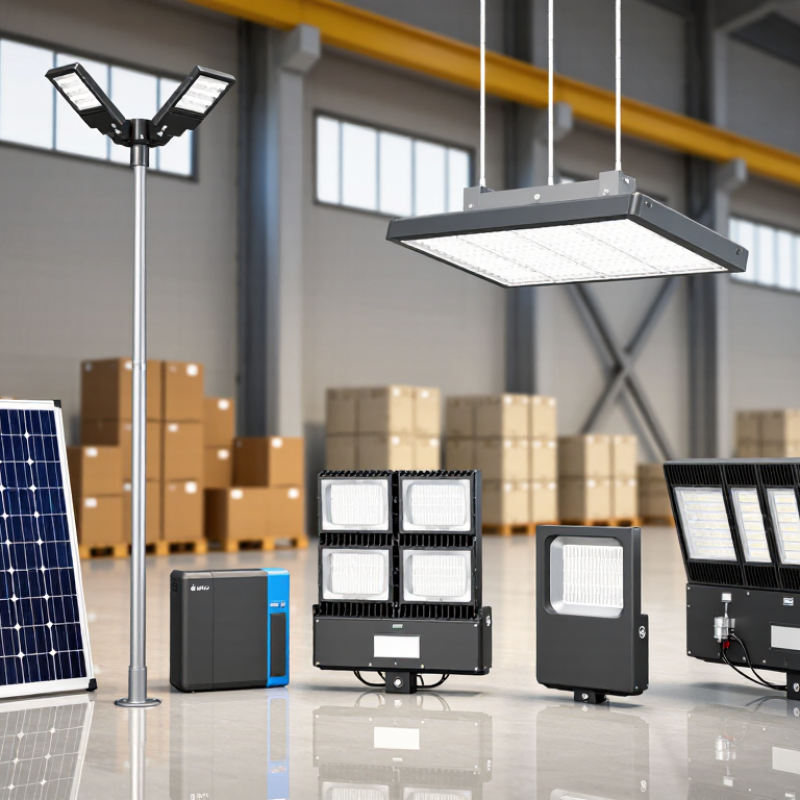
What Are Industrial Solar Lights and How Do They Work?
Industrial solar lights are outdoor lighting systems designed for factories, warehouses, ports, roads, and construction areas. They use photovoltaic panels to convert sunlight into electrical energy. A charge controller manages that energy and stores it in a battery. At night, the battery powers LED modules through a programmed control system.
These lights can operate away from utility lines. That makes them practical for remote yards and expanding industrial sites. A typical unit includes a solar panel, battery, LED lamp, controller, pole bracket, and weather-resistant housing. Sensors may reduce brightness when movement is absent. They can then increase illumination when workers or vehicles approach. Simple in concept.
Performance depends heavily on site conditions. A shaded panel may charge poorly, even when the product specification looks impressive. Battery capacity, panel angle, local winter sunlight, and dust exposure require careful checking. In coastal areas, corrosion-resistant materials matter. In dusty yards, regular panel cleaning can improve charging efficiency. When evaluating suppliers in China, buyers should request test reports, operating-temperature data, battery-cycle information, and protection ratings. A higher wattage alone does not guarantee better lighting. That is an easy mistake. On-site observation remains valuable because real environments often differ from laboratory tests.
Key Criteria for Evaluating China’s Industrial Solar Light Suppliers
China Top 10 Industrial Solar Lights Suppliers
Key Criteria for Evaluating China’s Industrial Solar Light Suppliers
A practical evaluation starts with lighting performance, not catalogue claims. Request photometric files, measured lumen output, beam angles, and tested illumination at ground level. A bright sample may still create dark areas beside a warehouse road. Check the LED driver, solar panel efficiency, and LiFePO4 battery capacity under realistic temperatures. Ask whether test data comes from an independent laboratory or an internal bench.
Durability matters more in industrial sites. Review IP and IK ratings, salt-spray results, wind-load calculations, and enclosure materials. Examine cable glands, charging controllers, and battery protection systems. Small sealing weaknesses can cause major failures after heavy rain. Suppliers should provide quality certificates, factory inspection records, and clear production procedures. ISO certification helps, but it does not replace product-level testing.
Supplier reliability also depends on communication and after-sales control. Confirm sample approval methods, inspection points, spare-part availability, warranty terms, and response times. A serious supplier should explain production tolerances instead of promising perfection. Request a pilot installation on several poles before placing a large order. Monitor charging time, night-time brightness, battery reserve, and performance during cloudy weeks. This step may reveal weaknesses that attractive samples hide. Pricing deserves attention, but an unusually low quote often reflects smaller batteries, thinner housings, or reduced testing.
China’s Top 10 Industrial Solar Light Suppliers
China Top 10 Industrial Solar Lights Suppliers
China’s Top 10 Industrial Solar Light Suppliers
China’s industrial solar lighting sector serves factories, warehouses, roads, ports, and remote work areas. The top ten suppliers should be judged by more than price. Practical experience matters. A reliable supplier can explain lighting layouts, battery sizing, pole strength, and installation limits clearly.
Strong suppliers provide photometric files, battery cycle data, controller details, and protection ratings. Look for tested performance under heat, rain, dust, and repeated charging cycles. IP65 or higher protection may suit many outdoor projects, but site conditions still require professional assessment. Ask for samples before ordering large quantities. A sample reveals beam uniformity, charging speed, cable quality, and night-time runtime.
Supply stability also matters. Check production capacity, quality inspections, spare parts, warranty terms, and technical support. Suppliers familiar with international electrical requirements can prepare clearer documentation for importers and project engineers.
However, product claims are not always equal to field results. Some test figures use ideal conditions. Real sites may face shade, winter weather, dirt, or weak mounting surfaces.
A careful ranking needs regular updates. Prices change. So do batteries, LEDs, and regulations. One weakness remains: online comparisons rarely show long-term failures. Buyers should request installation references and review after-sales records before choosing among China’s top ten industrial solar light suppliers.
Product Categories and Applications in Industrial Settings
China Top 10 Industrial Solar Lights Suppliers
Industrial solar lighting is no longer limited to rural paths. In factories, ports, warehouses, and logistics yards, buyers compare high-bay fixtures, area floodlights, solar streetlights, and perimeter lamps. Each category serves a different lighting geometry. High-bay units suit tall interiors, while floodlights cover loading zones and security approaches. Street and area units guide trucks across open yards without trenching power cables. Perimeter models need controlled glare and dependable motion sensing. Small details matter. Mounting height, beam angle, battery enclosure, and maintenance access can change the real project cost.
IRENA’s Renewable Capacity Statistics 2024 recorded 1,419 GW of global solar PV capacity at the end of 2023. The IEA’s Renewables 2024 report states that solar PV represented about three-quarters of renewable capacity added in 2023. This growth supports wider use of autonomous lighting, but it does not guarantee good illumination. Industrial buyers should examine nighttime autonomy, winter performance, dust resistance, and battery replacement intervals. A lamp rated for twelve hours may deliver less after cloudy days or battery aging. Test records are more useful than polished claims.
For Chinese suppliers, evaluation should include photometric files, battery cycle data, ingress protection testing, and written warranty terms. IP65 may suit exposed yards, but salt spray and poor drainage can demand stronger protection. In warehouses, occupancy controls reduce unnecessary runtime, although sensor settings often need adjustment after installation.
A recurring mistake is oversizing the panel while undersizing the battery. It appears during long winter nights. Pilot installations, lux measurements, and comparable project records can reveal weaknesses before full procurement. Price remains important. It should not replace evidence.
How to Select the Right Chinese Supplier for Your Project
China Top 10 Industrial Solar Lights Suppliers: How to Select the Right Chinese Supplier for Your Project
Selecting a Chinese solar lighting supplier requires more than comparing unit prices. Check the supplier’s factory capacity, engineering team, and experience with industrial sites. Ask for product drawings, battery specifications, LED performance data, and outdoor test reports. A dependable supplier should explain how the light performs during several cloudy days. Request samples before placing a large order. Inspect the aluminum housing, cable seals, mounting brackets, and controller settings. Small weaknesses become expensive after installation.
Tips: Compare suppliers using the same technical requirements. Confirm lighting levels, operating hours, battery chemistry, panel size, and warranty terms. Ask whether testing follows recognized international standards. Verify certificates independently when possible. Review previous project photos, but do not treat photos as proof. A site visit or live video inspection is more useful. Also confirm production lead times, spare parts, packaging, and after-sales response procedures.
Price still matters, but the lowest quote may hide thinner materials or weaker batteries. Discuss delivery delays before signing. Clarify who pays for replacement parts and technical support. I would also test one unit through a complete night cycle, then repeat it after partial charging. This step feels slow. It can reveal poor charging control. No supplier is perfect, and project conditions vary. A reliable partner admits limitations and adjusts the design instead of promising identical performance everywhere.
China Top 10 Industrial Solar Lights Suppliers: Project Selection Priorities
This chart presents a practical evaluation framework for comparing Chinese industrial solar light suppliers. The percentages are recommended procurement weights for a typical commercial or infrastructure project, not company-specific performance data.
Related Posts
-
Future of Solar Lighting Market Insights for Global Buyers and How to Optimize Your Procurement Strategy
-
Ultimate Guide to Choosing the Best Solar Panels Lights for Your Business
-

The Future of Best Solar Lighting Innovations Transforming Global Energy Solutions
-
Exploring Solar Lighting Outdoor Innovations at the 2025 China Import and Export Fair
-
Exploring Innovative Solar Lighting Alternatives for Sustainable Global Supply Chains
-
What Are the Top LED Solar Lights for Global Buyers?