
Top 10 Outdoor DIP LED Display Manufacturers Worldwide
A DIP LED display outdoor system is judged in full daylight, not in a product brochure. Sunlight can wash out colors. Rain can find weak seals. A loose connector may turn a bright cabinet into a dark patch. These details matter when buyers compare manufacturers, because a high-resolution specification alone cannot prove dependable outdoor performance. The right supplier must also explain brightness, pixel pitch, cabinet protection, heat management, service access, and spare-parts support in terms that match the installation site.
This guide introduces ten manufacturers serving the global outdoor LED market and considers what their products and support can mean in practice. It looks beyond headline specifications to the questions buyers should ask: How does the display handle direct sun? Can a technician replace a module without dismantling an entire wall? What evidence supports the stated weather protection? As a practical principle, outdoor display engineer Alex Chen puts it: “A display is only as reliable as its weakest cabinet, connector, or service plan.” Treat that as a reminder, not a guarantee. Manufacturer claims deserve careful checking against project requirements, documented test results, and the realities of the site. No shortlist can replace that work.
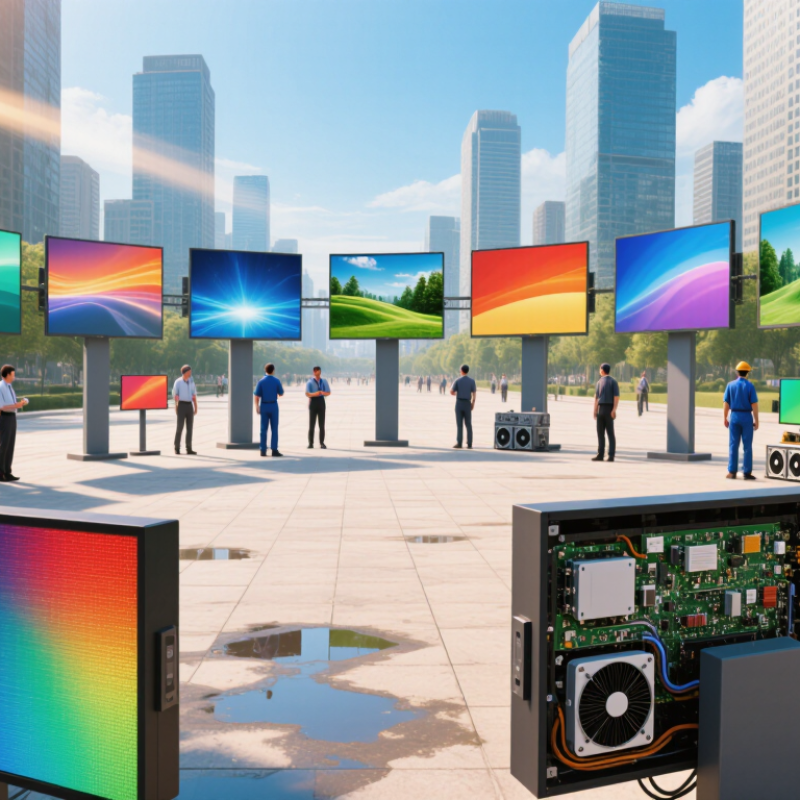
What Defines an Outdoor DIP LED Display and Its Core Features
An outdoor DIP LED display uses dual in-line package LEDs mounted through circuit boards. Each pixel contains separate red, green, and blue LED units. This structure delivers strong brightness, wide viewing angles, and reliable visibility under direct sunlight. It also handles long operating hours better than many indoor display designs.
Built for exposure, these displays usually include sealed cabinets, waterproof modules, UV-resistant masks, and corrosion-protected frames. An IP65-rated front surface helps resist rain and dust, but sealing quality still depends on cabinet assembly. Practical field tests matter. A display may pass a factory test yet develop moisture problems after repeated temperature changes. Heat management is equally important. Fans, vents, and aluminum structures must move heat away from the LEDs. Poor thermal control can reduce brightness and shorten service life.
Tips: Check brightness, pixel pitch, refresh rate, and viewing distance together. Ask for outdoor aging data, not only laboratory claims. Inspect spare-part access before installation. Keep brightness adjustable, because maximum output is not always best. Dust, glare, and nearby signs can change real viewing conditions. Even experienced buyers sometimes overlook maintenance space. That small mistake can make routine repairs slow and expensive.
How to Evaluate Outdoor DIP LED Display Manufacturers
Evaluating an outdoor DIP LED display manufacturer starts with the conditions your screen will face. Ask for test records covering brightness, color consistency, and operation across expected temperatures. A sunny roadside installation needs different performance evidence than a shaded sports venue. Request sample modules and inspect the pixels closely. Look for uneven color, loose connections, and visible gaps between cabinets. Small flaws matter.
Weather protection deserves practical verification. Ask how the cabinet handles rain, dust, and heat, and whether the stated protection rating applies to the complete display or only selected components. Clarify how technicians replace a module and what tools they need. Then review warranty terms, spare-parts availability, and response times in writing. Specific answers build confidence. Vague promises do not. If possible, speak with an operator whose display has run outdoors for several seasons. Ask what failed, how quickly parts arrived, and whether brightness changed over time. A factory visit can help, but it is not proof of long-term reliability. I would also compare power consumption using the same content and brightness settings. One detail is easy to overlook: installation quality affects performance, yet manufacturer guidance can be incomplete. That deserves a direct conversation.
Top 10 Outdoor DIP LED Display Manufacturers Worldwide – How to Evaluate Outdoor DIP LED Display Manufacturers
Use these ten evaluation criteria to compare suppliers. The table is a practical assessment framework, not a ranked list of named manufacturers.
| No. | Evaluation Area | What to Check | Useful Evidence |
|---|---|---|---|
| 1 | Outdoor product experience | Confirm experience producing direct-view outdoor DIP LED displays for the intended application and environment. | Comparable project references, installation details, and product documentation. |
| 2 | LED package and configuration | Verify that the proposed display uses DIP LED packages and that pixel pitch, color configuration, and viewing distance suit the site. | Datasheets, module specifications, and a sample or demonstration. |
| 3 | Brightness and visibility | Check documented brightness, viewing angle, and readability under expected daylight and viewing conditions. | Test reports or specifications stating measurement conditions and operating settings. |
| 4 | Weather protection | Assess protection against rain, dust, and moisture, including the front, rear, cabinet joints, and cable entries. | Declared IP rating, test documentation, and cabinet construction details. |
| 5 | Thermal management | Check operating temperature limits, heat dissipation design, and any derating guidance for hot or cold climates. | Product manual, thermal test results, and maintenance requirements. |
| 6 | Electrical safety and efficiency | Review power input, maximum and typical power consumption, grounding, protection, and applicable market requirements. | Electrical specifications, wiring diagrams, and relevant conformity documents. |
| 7 | Cabinet and installation design | Evaluate cabinet material, structural interfaces, access for servicing, mounting requirements, and suitability for the installation method. | Drawings, cabinet weight, installation instructions, and project-specific engineering review. |
| 8 | Quality control and consistency | Ask how LED modules are tested, how color and brightness consistency are managed, and how finished displays are inspected. | Inspection procedures, aging-test records, and sample acceptance criteria. |
| 9 | Serviceability and spare parts | Confirm access to replaceable modules and components, troubleshooting support, and spare-parts availability for the project period. | Service procedures, spare-parts list, and written support commitments. |
| 10 | Warranty and delivery capability | Review warranty coverage, exclusions, lead time, packaging, shipping responsibilities, and the process for resolving defects. | Written quotation, warranty terms, production schedule, and delivery plan. |
Compare like-for-like quotations using the same pixel pitch, cabinet dimensions, operating conditions, and warranty scope. Verify performance claims against project requirements before ordering.
Profiles of Ten Leading Outdoor DIP LED Display Manufacturers Worldwide
A useful comparison of ten leading outdoor DIP LED display manufacturers should focus on engineering strengths, not slogans. One may specialize in large stadium screens, while another builds rugged roadside displays. A third may offer fine-pitch outdoor modules; a fourth may prioritize high-brightness public signage. Look for clear pixel-pitch options and documented cabinet protection.
Other profiles may highlight regional production, custom-shaped installations, or modular systems that simplify repairs. Some manufacturers emphasize long-term component testing and consistent color calibration. Others stand out through responsive technical support or detailed installation guidance. A strong supplier should explain viewing distance, brightness, power use, and maintenance access in practical terms. Ask for measured data. Brochures alone can be thin evidence.
Tips: Compare sample images in daylight, inspect cabinet seals and cable connections, and request operating-temperature specifications. Ask how failed modules are replaced. A small detail matters: poorly placed service doors can complicate routine work. Also, ratings do not tell the whole story; installation quality and local conditions affect performance. I would avoid treating any single specification as decisive. Manufacturers sometimes describe the same feature differently, so verify what is included in the quotation.
How Manufacturer Products Compare in Performance and Application
Outdoor DIP LED displays are often selected for large signs, stadiums, transport hubs, and roadside information boards. Manufacturers differ in more than headline brightness. Buyers should compare pixel pitch, viewing distance, refresh rate, cabinet sealing, and service access.
Small details matter. A weather-resistant cabinet can still be difficult to maintain if modules are awkward to remove.
For direct sunlight, high brightness and effective heat management help preserve legibility and operating stability. Yet maximum brightness is not always the best choice. At closer viewing distances, a tighter pixel pitch can produce clearer text and images, while wider spacing may suit large signs viewed from across a road.
Compare measurements under stated conditions, not just marketing labels. Ask how performance changes with temperature, rain exposure, and extended daily operation.
Application should guide the comparison. A sports venue may prioritize fast image refresh and broad viewing angles; a roadside installation may need readable messages from farther away. Check power consumption, spare-module availability, warranty terms, and the manufacturer’s environmental test documentation.
These are practical questions, not glamorous ones. Published figures can be hard to compare when testing methods differ, and I would not treat a single specification as proof of long-term reliability. Requesting sample footage or a site reference can reveal issues that a data sheet misses.
Emerging Trends in Outdoor DIP LED Display Manufacturing
Outdoor DIP LED manufacturing is shifting from simple brightness targets toward balanced performance. Buyers now compare daylight readability, heat control, service access, and power use. MarketsandMarkets estimated the global LED display market at USD 7.1 billion in 2024, forecasting USD 10.5 billion by 2029. That estimate covers LED displays broadly, not DIP panels alone, so it should not be treated as a DIP-specific growth rate.
The practical changes are visible on the factory floor. More manufacturers are refining cabinet sealing, drainage paths, and corrosion-resistant connections for rain-exposed installations. They are also improving module-level replacement, so technicians can swap a failed section without removing an entire screen. Better thermal design matters too: hot cabinets can shorten component life and raise operating costs. Remote monitoring is becoming more common, helping operators detect abnormal temperature or power draw early. Still, sensors cannot compensate for poor installation.
Efficiency claims deserve scrutiny. A screen’s actual consumption depends on content, brightness settings, climate, and operating hours. The International Energy Agency’s Energy Efficiency 2023 report identifies efficiency improvements as an important route to reducing energy demand, but it does not provide a DIP-display-specific benchmark. Manufacturers should therefore publish test conditions alongside power figures. Real measurements matter. For buyers, the next step is checking full-white power, typical-content power, and maintenance access under realistic outdoor conditions.
Outdoor DIP LED Display Manufacturing: Water-Ingress Protection Levels
IEC 60529 IPX water-protection code levels, shown by their numerical designation.
For outdoor display manufacturing, enclosure design and ingress-protection testing are important considerations. The IPX numeral is a protection classification, not a linear measure of performance: level 7 covers temporary immersion under specified conditions, while level 8 covers immersion under conditions agreed between the manufacturer and user.